How
Systems
Shift
Healing is a pathway to systems transformation
Many efforts to change systems focus on policies, programs, institutions, and structures. While these are important, they often overlook a deeper truth: systems are shaped by the ways people make meaning of themselves, one another, and the world around them.
The assumptions we hold, the relationships we build, the stories we tell, and the actions we take are all influenced by deeper patterns of connection and disconnection.
At Collective Change Lab, we believe that lasting systems transformation requires healing. Healing allows individuals, communities, and institutions to move beyond inherited patterns of separation, trauma, extraction, and domination toward greater connection, belonging, and collective flourishing.
When healing occurs, new possibilities for meaning-making emerge. People begin to see themselves, each other, and the systems they inhabit differently. From these shifts in meaning come new ways of relating, organizing, governing, and creating change.
How recognizing trauma in ourselves, other people, and the systems around us can open up new pathways to solving social problems. Read our article Healing Systems
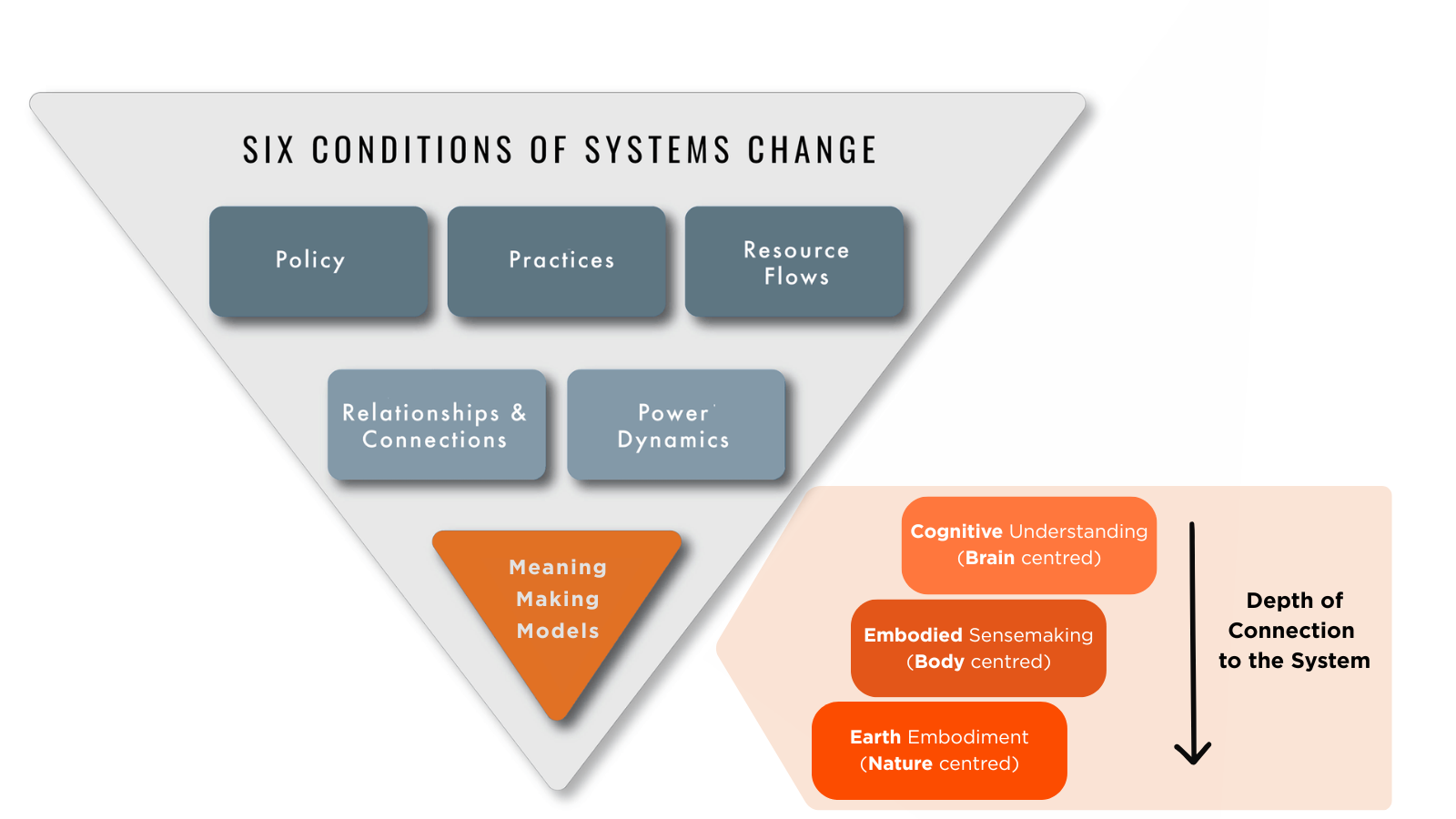
The Six Conditions of Systems Change framework identifies mental models as the deepest leverage point for transformation.
Our work builds on this insight by recognizing that meaning-making is not only cognitive. Human beings make sense of the world through mind, body, relationships, history, culture, and our connection to the living world.
We therefore think of systems transformation as shifting Meaning-Making Models.
These meaning-making models exist at multiple levels of depth.
Learn more and read "Water of Systems Change" (2018) and "How Embodiment Transforms Systems Change" (2026)
Cognitive Understanding
The stories, assumptions, beliefs, and narratives through which people understand the world. This level helps people develop awareness and new perspectives. It is often where systems change efforts begin.
Embodied Sensemaking
The felt experience of ourselves in relationship with others. This level recognizes that transformation rarely happens through information alone. People often change through experiences of connection, trust, belonging, grief, joy, and collective action.
Earth Embodiment
A deeper awareness of our interconnectedness with the living world.
At this level, people move beyond seeing themselves as separate individuals and begin experiencing themselves as participants in larger living systems. This shift can transform how we understand stewardship, responsibility, reciprocity, and collective wellbeing. The deeper our connection to ourselves, one another, and the living world, the deeper our capacity to transform systems.

❋
The Evolution of Our Thinking
Healing Systems represents the next chapter in Collective Change Lab's evolving thinking. It builds upon our earlier 5 Qualities of Transformational Systems Change framework, extending it with insights from collective healing, trauma integration, and embodied systems practice.
Four ways healing shifts systems
We have observed four interconnected pathways through which healing transforms meaning-making and creates conditions for systems change.
-
Systems often persist because people inherit stories and assumptions that appear natural, inevitable, or unquestionable.
Introducing new narratives, cognitive frames, and ways of understanding helps people see beyond existing limitations and imagine new possibilities.
Stories can reveal hidden patterns, challenge dominant assumptions, and help people understand their role within larger systems.
When understanding shifts, new forms of action become possible.
-
Many of today's challenges are rooted in disconnection.
Disconnection from one another. Disconnection from community. Disconnection from culture and ancestry. Disconnection from nature.
Healing occurs when people experience meaningful connection and belonging.
By creating spaces where people can build trust, bridge differences, and recognize their interdependence, we create conditions for new forms of collective action and shared power to emerge.
Transformation often begins with the realization that we are not separate from one another.
-
People rarely transform because they encounter a new idea.
More often, transformation emerges through lived experience.
Experiences of collaboration, collective leadership, mutual care, creativity, ritual, reflection, and community can reshape what people believe is possible.
These experiences create embodied knowledge that cannot be achieved through analysis alone.
When people experience a different reality, they begin to imagine and create different futures.
-
Many systems carry the imprint of historical and ongoing trauma.
Patterns of domination, extraction, exclusion, and harm become embedded not only within institutions but within bodies, relationships, and communities.
Healing creates opportunities to acknowledge harm, process grief, restore connection, reclaim wisdom, and cultivate resilience.
This work is not separate from systems transformation. It is foundational to it.
As people heal, communities heal. As communities heal, systems can evolve.