Use this site to find practical guides, facilitation tools and activities, shared principles, and experiential stories for applying systems storytelling as a healing practice.

Systems Storytelling Hub

Systems Stories

The stories we tell shape what we can imagine and how we see possibility. 

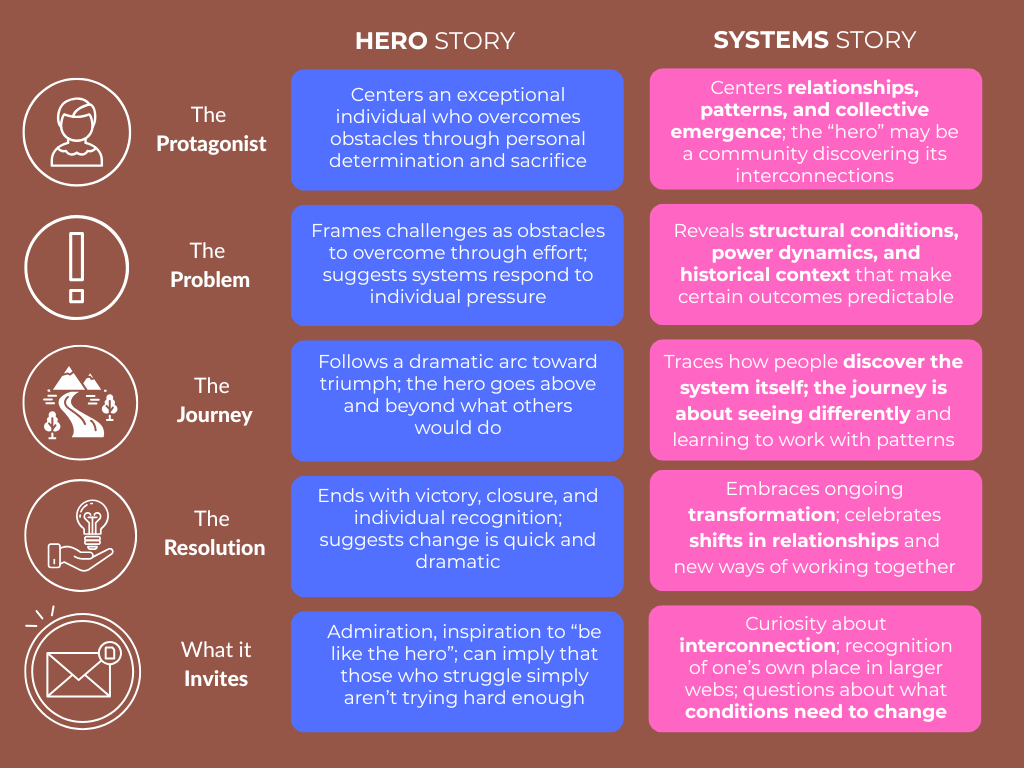
Hero stories and systems stories both have their place, but they reveal different truths and invite different kinds of action.
The Core Shift

Systems are made of people. Not organisational charts or flowcharts—relationships. A hero story arrives, finished. We receive it, admire it, move on. A systems story is made together—and the making is part of the point.

To understand a system, you have to invite it into the room. Bring together people who don't normally sit together, each holding a different perspective and experience, and create conditions for stories to surface. Then listen across them.

One person describes a door that kept closing. Another describes being told to keep that door closed. A third didn't know the door existed—they came in another way.

Suddenly, the system is in the room. What seemed intractable shows its seams. We see where things are fraying—and where people have already found other ways through.

The question shifts from "What did this one person do?" to "What are we seeing together that none of us could see alone?"

What’s at stake

Every story teaches us what’s possible.

Hero stories—narratives of exceptional individuals overcoming obstacles through determination and sacrifice—are one way of making sense of change. They’re familiar, satisfying. And in many contexts, they’re the only stories that get told, funded, and believed. But they come at a cost.

When we tell only hero stories, we train ourselves to look for remarkable individuals rather than understand conditions that made change possible. We celebrate personal triumph while leaving systems intact. We imply that those who struggle simply aren’t trying hard enough. Collective action becomes invisible and unnecessary, and we lose the opportunity to learn how deep, lasting change happens. 

Some storytelling traditions have always held complexity differently. Indigenous narratives, oral traditions rooted in relationship and place, and ways of knowing that locate agency in community and connection to land have never reduced change to individual achievement. For these traditions, systems stories aren’t new. They’re ancestral—living knowledge systems, not metaphors to be borrowed from.

Others of us are relearning what dominant culture trained out of us: how to see patterns, how to narrate relationships, how to tell stories that resource entire movements rather than simply inspire individuals.

This matters now. The challenges we face—climate collapse, systemic racism, economic extraction, failures of care—cannot be addressed by heroes alone. They require us to see differently: to understand how we are implicated and connected, and to act together.

We need stories that make that kind of action imaginable.

What is a systems story?

A systems story it reframes how we understand agency.

Instead of asking:
“What did this remarkable person do?”
a systems story asks:
“What conditions made change possible—and who else was involved?”

Systems stories can be just as emotionally compelling, just as rich with character, and just as narratively satisfying as any hero’s journey. Yet they require different craft—different questions, different muscles—but they move us just as deeply.

A hero story follows a single river—tracing its dramatic course from source to sea. A systems story maps the watershed: the tributaries, the groundwater, the rainfall, the land that shapes where water can and cannot flow. Both are true. But if you want to understand why the river is drying up, you need to see the whole basin.

  • Where a hero story centers an individual protagonist, a systems story might center a relationship, a pattern, or a community coming into awareness of its own interconnection.

  • Where a hero story ends in victory and closure, a systems story stays with ongoing learning and transformation.
    Where a hero story invites admiration, a systems story invites recognition—of one’s own place in larger webs, of what conditions need to change, and of whose knowledge has been missing.

Where this comes from

Over two years, we convened storytellers, artists, researchers, and practitioners across six countries and ten disciplines. Together, we experimented—testing approaches grounded in systems thinking, healing, and narrative craft. We failed, learned, refined, and tried again.

What you’ll find here is a body of learning drawn from people doing the work in real contexts, with real stakes.

Systems Storytelling Fellowship Program
Collective Change Lab

Over two years, Collective Change Lab convened storytellers, artists, researchers, and practitioners across six countries and ten disciplines to explore how systems thinking, healing-centered practice, and narrative craft can work together to shift the conditions shaping our communities. Together, this cohort stepped into a shared experiment—testing ideas in real contexts, with real stakes, and learning through both breakthroughs and setbacks.

We walked this learning journey alongside one another—prototyping tools, challenging assumptions, and holding space for complexity and possibility. Fellows applied insights from the fellowship within their own organizations and collectives, influencing strategy, shifting narratives, and strengthening relational trust.

What emerges here is a living body of practice: learning generated by people doing the work. The Systems Storytelling Fellowship is not only about telling better stories—it is about transforming the systems those stories sustain, and expanding the possibilities for collective healing and change.

The Six Storytelling Collectives

“stories are like individual stars, narratives are constellations of stories, and cultures are like huge, expanding galaxies. Individual stories by themselves cannot drive change, but when they are linked together, they can immerse us in new narratives that can shift culture in profound ways.” - Jeff Chang, Liz Manne and Erin Potts

Click on any constellation point to explore the diverse collectives that form our storytelling community. Each collective brings unique perspectives and approaches to systems storytelling