Red Teapot Collective
(Ontario, Canada)
Context setting
Lori Flinders and Carrianne Agawa, stories have never been separate from healing. Never separate from community. Never separate from land, ceremony–the relationships that sustain life. The question was never how to integrate storytelling with systems thinking—it was how to get Western systems to recognize what Indigenous practice has held together for millennia.
Through the Red Teapot Collective, they work within Indigenous communities facing the opioid crisis, which is viewed a symptom of deeper wounds: colonization designed not just to take land, but to destroy Indigenous families, culture, language, and the bonds between generations.
Why now
Western medical approaches treat individuals in isolation, and policy responses often criminalize or pathologize. At the same time, the very structure of formal healthcare in Ontario fragments what needs to stay connected, separating mental health from physical health, treatment from culture, the person from their community and territory.
Indigenous communities continue to be studied and treated by outside experts instead of being recognized as holders of healing wisdom. The validity of Indigenous stories, medicines, and community-based knowledge systems are often dismissed as "unscientific", “alternative” or "anecdotal". This dismissal is built into how evidence itself gets defined: what counts must be clear, coherent, or verbally articulable. But Indigenous practice holds silence as meaningful, contradiction as lived truth, the body as remembering what policy forgets. These ways of knowing don't fail evidence standards—they challenge the standards themselves.
Meanwhile, the formal systems most implicated in the opioid crisis, including healthcare, child welfare, criminal justice, continue to exclude the very practices that could heal them: ceremony, land-based healing, storytelling that holds individual and community together.
What they tested
Lori and Carrianne tested whether traditional healing practice could create bridges to broader healthcare, governance, and education systems.
In the Collective, stories do not move outward as personal testimonials. In storytelling circles, trauma is externalized, and what felt like personal failure becomes recognizable as system failure. When these stories travel beyond the circle into healthcare or policy spaces, personal details stay behind and systemic insights travel forward. For example: systems create conditions for addiction, reconnection to community and land makes healing possible, and so on.
These structural insights emerge from the practice itself. Community members share stories in culturally grounded ways that include language, song, ritual, land-based medicines, art, and sacred bundles. In this process, "person" and "community" are intimately connected. As stories accumulate, patterns become visible. Repeated disruptions: child apprehension, disconnection from land, criminalization, underfunded cultural care. Repeated strengths: ceremony, aunties, language, land, humour, joy. These patterns explain why policies fail, expose what systems consistently exclude, demonstrate where investment actually heals.
They also brought to the Fellowship a challenge to how storytelling itself is understood outside Indigenous communities. For example, in ceremony, the cedar spirit is telling its story, the water spirit is telling its story, the sacred tools and the fire all have story ingrained in them.
What's Shifting
This is not a new methodology. The storytelling circles demonstrated what Indigenous practice has always held: the capacity for multiple truths at once. Stories of unimaginable hardship, laughter, desire, joy, dreams for wellness, healing, transformation.
As these stories travel beyond the community into healthcare settings, policy discussions, and academic spaces, something shifts. For example, pathways are beginning to emerge for Indigenous healing approaches to influence these systems rather than being marginalized by them..
In these encounters, the Collective has resisted extracting stories from the relationships that hold them. Instead, what gets translated are principles, such as: healing is collective, land is medicine, listening is intervention. care must be relational, not transactional. Most profoundly, systemic failures are made visible. This is storytelling that creates obligation.
Connected to These Learnings
Silence, contradiction, and the body are part of the story
Lori Flinders-McMillan
Fellows
Chief Executive Officer, Binesiwag Center for Wellness, Storyteller, Ceremony facilitator, Midewin,
Approach to Work
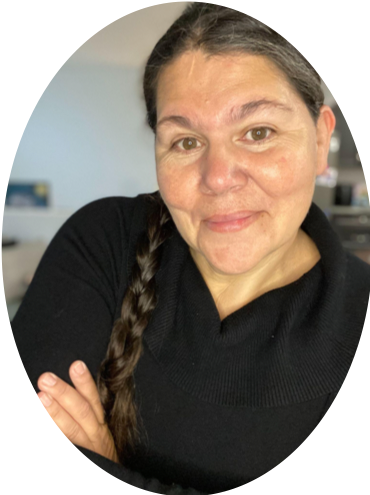
Lori Flinders-McMillan, co-owner and Chief Executive Officer of the Binesiwag Center for Wellness, is an Anishinaabekwe from Couchiching First Nation in Southern Treaty 3 in Canada. She is from the Lynx Clan with matriarchal Bear Clan lineage. Lori carries an Anishinaabe Traditional bundle and holds knowledge in ceremonies, medicines, and land based healing methodologies. She has relationships with numerous Elders, Knowledge Keepers, Helpers, and Healers.
As a co-leader of the Red Teapot Collective, Lori addresses the opioid crisis in First Nations in Canada—a crisis that disproportionately devastates Indigenous communities. She grounds her work in Indigenous practices, art, story-telling, relationship-building, and healing, bringing a practice of listening passed down through generations and the knowledge that individual and community healing cannot be separated.
Her storytelling work confronts a crisis born from colonization, residential schools, child removal policies, and ongoing systemic racism. In this context, storytelling is not a tool for change—it is the restoration of what colonial systems tried to destroy: voice, relationship, ceremony, and the bonds between generations.
Beyond the work
My family is why I do what I do. I think about the next seven generations and how my existence can shake up systems that continue to make the world an unsafe space. I strive to break down barriers through my work while adding to the body of knowledge that promotes love, harmony, peace, and sustainable futures. I do this for my children, grandchildren, and all of my relations.
The work at BCW is multilayered and heart led by a group of Indigenous women who have lived experience in human trafficking, family violence, addictions, and child welfare. Lori is currently completing her Doctorate in Indigenous Knowledges at Blue Quills University in Alberta. She has a Master’s Degree in Social Work and is a certified First Nations Health Manager. Lori is also working towards understanding Indigenous menopause and bring voice to the Mindemo’weyag (women who hold it together) through her clinical practice.
Selected connections
Carrianne Agawa
Owner and Senior Consultant of Maadjitawin Consulting, Facilitator, Storyteller, Artist and Windigo KaaN - B.A.Hons Psychology, M.Ed., AT (Art Therapy) & EaT (Expressive Arts Therapy)
Approach to Work
Carrianne Agawa comes from the Whitefish River First Nation in the Robinson-Huron Treaty area. She is an Ojibwe woman and a WindigoKaaN (Contrary) from the Turtle clan. With a Masters in Education and an Honors degree in Psychology, she skillfully infuses Indigenous and Western knowledge in her work as a WindigoKaaN, storyteller, artist, facilitator, motivational speaker and consultant.
Together, Carianne and Lori lead the Red Teapot Collective, which addresses the opioid crisis, focusing on women and indigenous communities. They ground their work in Indigenous practices, art, relationship-building, and healing to address the crisis.
Carrianne brings the WindigoKaaN tradition of using humor, contradiction, and the unexpected to reveal what needs to be seen. She holds the understanding that the opioid crisis is not an isolated event but a thread in a longer story of imposed systems and resistance. And she brings the insistence that stories contain both medicine and fire—that even amid unimaginable hardship, communities express laughter, desire, joy, and dreams for transformation.
Beyond the work
I have two adult children, three beautiful grandchild (noshis), have fostered many children and currently have the attention of two rescued labs and two cats. My life is full of wonderful adventures; kokom (grandmother) is a new adventure that I am rocking in at the moment. I enjoy being on the land, running, creating art and writing stories.